
By Chuck Gallagher — Business Ethics Keynote Speaker and Trainer
TL;DR: Chuck Gallagher, AI ethics speaker and author, examines three federal enforcement actions from June and July 2026 and finds the same failure underneath all of them — somebody let a machine, a brand name, or a checked box stand in for the work, and the liability landed on the humans anyway.
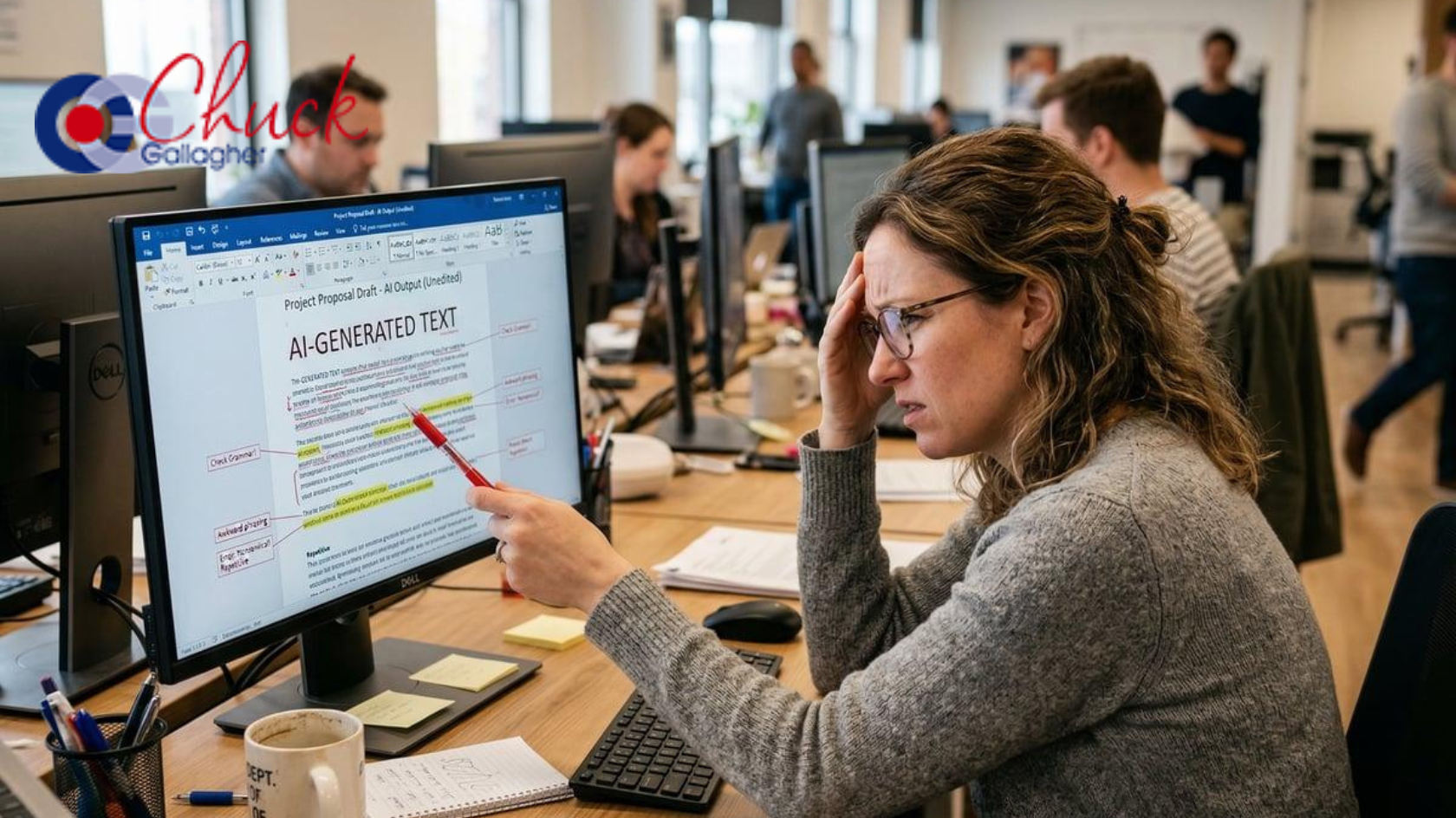
A federal judge went looking for a case called Taylor v. Hott.
She had the citation right there in front of her. The Justice Department had put it in a filing opposing an ICE detainee’s habeas petition — 724 F. App’x 387, a Sixth Circuit decision, quoted language and all. So Judge Hala Jarbou turned to page 387. What she found was an opinion called Atkins v. CGI Technologies & Solutions. Commercial arbitration. Nothing to do with an immigration bond.
She kept looking. No Sixth Circuit case carried that caption. No federal case anywhere contained the quoted language. Her conclusion, filed this week in the Western District of Michigan: the citation was “likely produced by generative artificial intelligence.”
She declined to sanction anyone. All she did was tell the Department of Justice that a lawyer using AI has to review its output scrupulously and confirm the cases exist.
Stop. You may want to read that last sentence again. A federal judge had to remind the largest law office in America to open the case before citing it.
Why Does “The AI Did It” Never Work as a Defense?
Because nobody delegated the signature.
As an AI ethics speaker and author, I hear the same sentence in every industry I walk into. It’s just research. It’s only the first draft. A human always reviews it. Fine. Then explain to me how a case that does not exist got past that human and into a federal court filing.
Here’s what twenty-some years of studying why decent people make lousy choices has taught me. Rationalization never announces itself. It shows up as a small, reasonable-sounding permission slip, and every one of those sentences moves the labor off your desk while leaving the consequence sitting exactly where it always was. On you.
Trust me, I know that pattern from the inside. I once talked myself into believing money I took wasn’t really stolen because I fully intended to pay it back. It’s really just a loan. No harm, no foul — so to speak. The mind is clever. It hands you a story that lets you keep moving.
What Does It Cost When the Story Outruns the Substance?
On June 26, 2026, a federal court in Colorado entered a default judgment against a firm named AI Financial Education Foundation Ltd. The SEC’s complaint alleged its July 2024 Form ADV claimed exempt reporting adviser status, Denver-area office space, ten million dollars in U.S. assets under management, and a private fund under its advice.
Impressive paperwork.
The SEC alleged that the business actually occupying that Denver-area office had never heard of the company or its purported chief executive. The separate registered adviser said to be reporting on the private fund had reported nothing. And when SEC attorneys asked the firm for records to substantiate its own filing, the firm didn’t answer.
The final judgment permanently enjoined the firm from violating Sections 204(a) and 207 of the Advisers Act, barred its owners and officers from ever filing an ADV as an exempt reporting adviser, and ordered a civil penalty of $1,182,254.
Now, notice what the SEC did not allege. It did not allege anyone misused an AI system. The letters A and I were just sitting there in the company name. That was enough to make the paperwork look like something. Two letters doing the job evidence was supposed to do.
Is Any of This Actually an AI Problem?
Here’s the case that answers that question. There’s no artificial intelligence in it at all.
On June 12, 2026, the FDA sent a warning letter to Nihon Kohden Digital Health Solutions in Irvine, California. The company makes heart-monitoring software called Next Generation NetKonnect — an arrhythmia detector and alarm, cleared under K220989 in July 2022. Three months later, the firm added a Silence Alarms function. It ran its own regulatory assessment, hit the decision point asking whether the change touched a control mechanism, and selected “No.” Letter to file. No new 510(k).
FDA disagreed, and said so plainly. Silencing an alarm changes the way a user controls the device. The risk the agency named: missed alarms for life-threatening conditions. The harm it named: serious injury or death. FDA also found the firm marketing “device-agnostic compatibility” when its clearance covered inputs from Nihon Kohden equipment only. Unvalidated inputs, the agency wrote, can produce incorrect vital signs or lose monitoring altogether. Delayed diagnosis. Misdiagnosis. Fifteen business days to respond. Seizure, injunction, and civil money penalties if the firm doesn’t correct it.
No algorithm made that call. A human being answered a yes-or-no question the way the human being wanted it answered.
That’s the whole point, and it’s why these three cases belong together. The failure underneath all of them is identical, and it predates every chatbot on earth. Somebody decided verification was optional. AI didn’t invent that shortcut. It just made it instant, frictionless, and downright beautiful to look at.
Where Does the Liability Actually Land?
On you. Every single time.
The judge didn’t sanction a model. The SEC didn’t fine a brand name. FDA isn’t mailing a warning letter to a software function. Regulators aren’t one bit confused about who’s responsible, and in my work as an AI ethics speaker and author I’ve never once seen an enforcement action pause to ask whether a tool wrote the sentence.
So put the gate where the exposure is. If your organization files anything with a court, a regulator, or a paying customer, somebody signs an attestation that they opened every cited source and confirmed it says what the filing claims. Opened it. Pulled it up and read the words with their own eyes. “Reviewed” is what people write down when they skimmed. If a change touches patient safety, the assessment gets a second reader with no incentive to check the easy box. And any claim your marketing makes about your own technology gets the same evidence test as a claim about your revenue. Same thing. This isn’t rocket science.
Let me be clear. I’m not telling you to put the tools down. I’m telling you the work AI took off your plate didn’t disappear. It moved. It’s sitting on your desk right now, unclaimed, waiting for the day a judge or an inspector picks it up and reads it back to you.
Every choice has a consequence. Including the choice not to look.
Frequently Asked Questions
Can a lawyer get in trouble for using AI in a court filing?
Yes. Courts have handled it unevenly, though. In the Michigan ICE detention case, the judge declined to impose sanctions but warned the Justice Department that future filings must not contain nonexistent legal authorities. Other courts have gone a good deal further — in June 2026 the Ninth Circuit sanctioned two attorneys $2,500 each and suspended them for six months over fabricated citations in an immigration brief. The consistent thread is simple enough. The duty to verify belongs to whoever signs the filing.
What did the judge say about AI in the DOJ immigration filing?
Judge Hala Jarbou found that a cited Sixth Circuit case did not exist at the page identified and could not be located anywhere in federal case law, and she concluded the citation was likely produced by generative AI. Any attorney using AI, she wrote, must review its work product scrupulously to confirm the cited cases exist and that the citations fairly represent the underlying law. Courts, she noted, are seeing a rash of filings with hallucinated authorities.
What is AI-washing, and how do regulators treat it?
AI-washing is dressing up a product, a firm, or a filing with artificial intelligence language that the underlying substance doesn’t support. Regulators treat the AI framing as a representation like any other, subject to the same evidence requirements. In the AI Financial Education Foundation matter, the SEC pursued misrepresentations in a Form ADV — office space, assets, and fund reporting that the complaint alleged could not be substantiated. The court entered a $1,182,254 civil penalty by default. Two letters. Seven figures.
Does a software change to an FDA-cleared device require a new 510(k)?
It does when the change could significantly affect the device’s safety or effectiveness, or when it amounts to a major change in intended use. FDA told Nihon Kohden Digital Health Solutions that adding a Silence Alarms function was a control mechanism change requiring a new 510(k), and that marketing device-agnostic compatibility went beyond the cleared intended use. A firm’s own internal assessment concluding otherwise does not settle the question.
Who is liable when an AI tool makes a mistake at work?
The organization and the individual who authorized the output. As an AI ethics speaker and author, I have yet to see a regulator or a court accept the tool as the responsible party. Liability attaches to the signature. The filing. The clearance. The claim. Whatever software drafted it doesn’t sign anything, which means, practically speaking, your verification controls are your liability controls.
Working On This In Your Organization?
Three federal actions in five weeks, three different industries, one identical hole where the verification was supposed to be. Your people are busy, and the tools are very good at looking finished. Nobody in that picture is being reckless. That gap — between output that looks done and work that actually is done — is where liability grows quietly until somebody official reads it out loud. I speak to boards, law firms, compliance teams, and healthcare organizations about the behavioral patterns behind exactly this kind of failure, and about the guardrails that hold when the pressure is on. If your team is moving faster than its verification can keep up, let’s talk before a judge does. Learn more or book a conversation at ChuckGallagher.com.
Five Questions for Reflection
1. Where in your organization does someone sign for work they did not personally verify — and would they be able to explain that gap to a regulator?
2. What is the permission slip your team uses? “It’s just a draft,” “it’s just research,” “Legal will catch it.” Which sentence do you hear most, and what does it excuse?
3. The Nihon Kohden assessment came down to one yes-or-no answer. Who in your organization answers questions like that alone, and who has an incentive for the answer to be “No”?
4. If your marketing claims about your own technology had to be defended with documents tomorrow, which claim would you pull first?
5. AI removed a step from someone’s job this quarter. Whose desk did that step land on, and does that person know it?
